Blog
Jellyblue Blog: Reading Around the Label
Quick answer
Three posts sit alongside the Jellyblue product pages. One reads the human evidence behind tongkat ali, the largest amount in the gummy. One explains why a milligram figure is worth more than a list of six names. One takes apart the white coat and the star rating on the sales page. Each links its sources.

What is on the Jellyblue blog right now?
Three posts are live. Each takes a question the product pages raise in a line or two and gives it room.
They are written for someone still deciding, not for someone who already ordered. The awkward parts stay in.
Jellyblue Gummies: What Is in Each Blue Raspberry Gummy
Gummies. One blue raspberry chewable a day: seven printed actives, the gummy base, storage and packs.
Read more →Jellyblue for Men: Who the Gummy Suits and Who Should Wait
For men. Who the gummy suits, who should ask a doctor first, and what it will not do.
Read more →Tongkat ali: what the evidence shows
Research. The largest amount in the gummy at 200 mg, and how thin the human research behind it really is.
Read more →Why milligrams matter more than ingredient lists
Labels. Six names on a graphic prove nothing. Seven numbers on a panel let you check the claim yourself.
Read more →White coats and star ratings in supplement ads
Advertising. A coat with no name attached, and a review block that repeats beside other products.
Read more →Which Jellyblue post answers your question?
Pick by question rather than by title. Every post stands alone and points back to the product page it touches.
| If you are wondering | Read | Then check |
|---|---|---|
| Whether the headline ingredient has evidence behind it | Tongkat ali: what the evidence shows | Ingredients |
| Why a published number beats a longer ingredient list | Why milligrams matter | Supplement facts |
| Whether the coat and the stars mean anything | White coats and star ratings | Reviews |
| Whether any of it is safe with your medicine | Side effects | Who it is for |
What does each post cover?
Tongkat ali: what the evidence shows
Tongkat ali is the largest single amount in the gummy at 200 mg, which sits roughly in the range small human trials have used. The post follows what those trials actually measured, how few people were in them, and why no federal fact sheet covers the herb. It ends where the honest answer is: limited evidence, a fair amount, no promises attached.
Why milligrams matter more than ingredient lists
The "Inside Jellyblue" graphic names six ingredients. The panel on the wrap lists seven, with a number beside each one. The post explains what a proprietary blend hides, why 650 mg split seven ways is a different thing from 650 mg of one ingredient, and how to read a panel against the amounts studies have used (NIH ODS).
White coats and star ratings in supplement ads
The sales page shows a person in a white coat holding the bottle, with no name, license or specialty published, and a row of review polaroids whose wording repeats beside other products. The post treats both as what they are: layout, not evidence. It also covers why the FDA keeps finding hidden prescription drugs in men's products sold online (FDA, 2026).
Why does a seller publish posts like these?
Jellybluemen earns money when you order, which is exactly why the posts have to be straight. A reader who feels sold to checks nothing and believes nothing later.
So the blog carries the parts a sales page skips. Maca at 100 mg is far under the amounts used in studies (Shin et al., 2010), and ashwagandha at 100 mg sits under the usual 300 to 600 mg (NCCIH, 2023). Both facts appear in print on a site that profits from the sale.
How is a Jellyblue post put together?
Every post follows the same four steps, which keeps the tone even and each claim easy to trace.
Start from the wrap
The seven actives, their milligrams and the printed cautions set the scope. Nothing outside the label gets invented.
Find the public source
Research comes from bodies such as NIH and NCCIH, or from a named systematic review, and the link goes in full at the foot of the page.
Compare the amounts
The figure on the panel is set against the range studies used. Grape seed at 50 mg against 100 to 300 mg, for instance (NCCIH, 2025).
Say what is unknown
Where no answer has been published, the post says so and points at the panel on your own bottle.
How do you check a supplement study without a science degree?
The posts use the same handful of checks every time, and they work on any product page you meet.
- Check the amount first. A result found at 3 grams a day says nothing about 100 mg.
- Check who was studied. Older adults, trained athletes and healthy students do not respond alike.
- Check the size. Twenty people for two weeks is a hint, not a finding.
- Check whether a review pooled the trials, and what it concluded about their quality.
- Check who paid. Funding does not void a study, but it belongs in your reading of it.
None of that needs a laboratory. It needs the study title, which is why every source used here is linked in full at the foot of the page it appears on.
What will you never read on this blog?
- Claims that the gummy treats, cures or prevents any condition
- A milligram figure that is not printed on the label panel
- Star ratings, review counts or customer stories of any kind
- Prices, savings or a deadline designed to hurry you
- A named expert, doctor or laboratory that has not reviewed this site
Findings are reported as they stand, including the inconvenient ones. A post that left out the gap between a 50 mg arginine figure and the grams used in blood-flow research would not be worth reading.
How does the blog connect to the Jellyblue product pages?
The posts explain the background. The product pages hold the specifics about this bottle, this pack and this refund window.
Start with the hub
Every guide and post in a reading order that runs from the label to the refund window.
Read more →Check the short answers
Thirty-five questions on the panel, the amounts, safety, packs and returns.
Read more →Read the panel itself
Every line of the Supplement Facts wrap, typed out and explained.
Read more →If a post and the bottle in your hand disagree, the bottle is right. Write to the website inbox in the site footer and the page gets fixed.
What comes next on the Jellyblue blog?
Nothing is scheduled. A post is added when a question comes up often enough to deserve its own page, and revised when a source moves or the label changes.
Questions about the Jellyblue blog
Who writes the Jellyblue blog?
Writers at Jellybluemen, working from the label wrap and public sources. No outside doctor, researcher or reviewer is named, because none has reviewed this site and inventing one would undo the point of the blog.
Are these posts about Jellyblue or about supplements generally?
Both. Each one starts from a question this label raises, widens to what is known about the category, then comes back to what it means for a gummy with seven published amounts.
Does the blog publish customer stories?
No customer quote, photo, star rating or review count appears anywhere on this site. The reviews page explains why the seller's review block is not republished.
Is anything here medical advice?
No. The posts summarise label facts and public research. A clinician who can see your history is the right person for advice about your own body, especially before starting anything new.
Does this site earn money from the blog?
Indirectly, yes. Jellybluemen stocks and sells the product without making it, and an order pays for these pages. That is why the posts report the amounts that fall short as plainly as the ones that hold up.
How often do the posts change?
There is no schedule. A post is revised when a cited source is updated, when the label or sales page changes, or when a reader reports an error in it.
Can you cover a topic I care about?
Send it to the website inbox in the site footer, staffed Mon-Fri 9:00am-5:00pm ET. That inbox handles website questions and cannot see orders, tracking or refunds.
Where do order questions go instead?
To the order desk, which covers tracking, changes and refunds. None of those is visible from the website inbox.
References
- U.S. Food and Drug Administration (2026). Tainted Sexual Enhancement Products.
- National Center for Complementary and Integrative Health (2023). Ashwagandha: Usefulness and Safety.
- National Center for Complementary and Integrative Health (2025). Grape Seed Extract: Usefulness and Safety.
- NIH Office of Dietary Supplements (accessed 2026). Dietary Supplements for Exercise and Athletic Performance.
- Shin BC, Lee MS, Yang EJ, Lim HS, Ernst E (2010). Maca (L. meyenii) for improving sexual function: a systematic review, in BMC Complementary and Alternative Medicine 10:44.
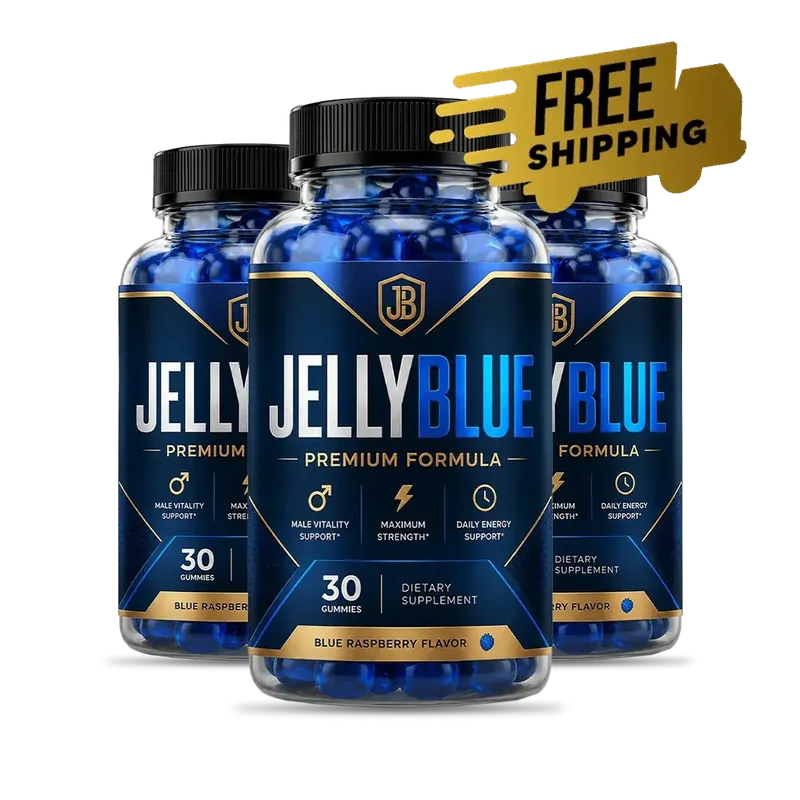
Ready when you are
Order Jellyblue from the authorized outlet
Packs of 1, 2, 3 or 6 bottles, 30 gummies each, priced on the secure order page. Every order has a 60-day money-back guarantee. Questions first? The contact page lists every desk.

Keep reading
Jellyblue Guides
The hub: two long guides, three posts and every product page, in a sensible reading order.
Read →AnswersJellyblue FAQ
Thirty-five short answers, each one clear about whether the fact comes from the label or nowhere at all.
Read →The productJellyblue Ingredients
All seven named actives, their milligrams, and the one the sales page leaves out.
Read →