Blog
White Coats and Star Ratings in Supplement Ads: Reading the Jellyblue Page
Quick answer
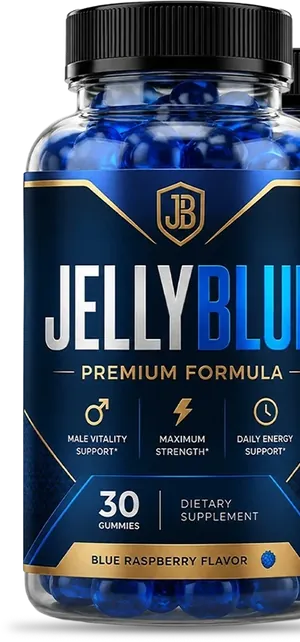
Supplement sales pages run on trust signals: a person in a white coat, a row of review polaroids, a star score, an order counter and a wall of seals. Almost none of it can be checked by a reader. The Jellyblue sales page carries the full set, which makes it a fair example to take apart honestly.
Start here
What is a trust signal, and why do sales pages use so many?
A trust signal is anything on a page designed to borrow credibility rather than earn it. Coats, stars, counters and seals all do the same job in different clothes.
They exist because a shopper cannot test a supplement before buying it. The page fills that gap with pictures of proof.
| What you see | What it suggests | What is missing |
|---|---|---|
| A person in a white coat | Medical authority | No name, license number or specialty is attached to the image |
| Review polaroids | Neighbors who bought it | Layout art with no date, order record or way to reach anyone |
| A star score | Thousands of opinions averaged | No sample, no method and no single review you can open |
| An order counter | A crowd already buying | A sales claim with no period, source or definition attached |
| A wall of seals | Independent checks passed | No certifier is named beside any of the marks on the pack |
| Bonus ebooks | Extra value at no cost | Digital files, which cost nothing more to hand out than to print |
What does a person in a white coat prove?

A coat is clothing. It becomes a credential when a name sits beside it, that name holds a license, and a board somewhere can take the license away.
None of that is printed on this sales page. The photograph sits near the words doctor developed, and neither the picture nor the phrase names anybody.
The test is quick and it works everywhere. Look for a name you could type into a state license search. If there is none, treat the picture as styling.
Phone the order desk and ask which physician worked on this formula. Until a name arrives that anyone can look up, the photograph carries no more weight than the bottle in it.
What is the row of polaroids doing there?
Filling a section, and borrowing the look of a shoebox of family photographs. Tilted frames and handwritten-style captions signal ordinary people rather than advertising.
The styling carries no information at all. Nothing in the row can be dated, traced or answered.
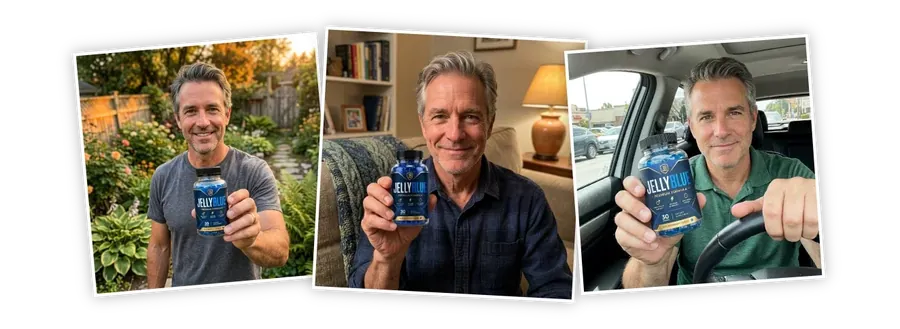
- No purchase date or order reference sits beside any image
- No way is offered to contact a person in the pictures
- No indication of which pack was bought, or for how long
- No platform where the same account could be read in full
What do a star score and an order counter actually measure?
Nothing a reader can inspect. The Jellyblue page shows a score out of five, a four-figure review count and a five-figure order number, and none of them carries a sample, a date range or a method.
Numbers like those are graphics with digits inside them. A score becomes useful the moment a reader can open the reviews underneath it, and these cannot be opened.
- The same block of score, counters and quotes turns up beside unrelated products
- Text repeated across a catalog describes a page template, not a customer
- A recommendation rate means nothing without the question that produced it
- An order count is a sales figure, and sales are not experience
The reviews page sets out the block line by line and explains how to judge supplement feedback without it.
What does a seal on the pack certify?
Usually a process, sometimes a policy, and almost never the product in your hand. The wall of marks is the trust signal shoppers misread most often.
Read each one as a sentence with a missing half, and the pattern becomes obvious.
| The mark | What it claims | What it does not cover |
|---|---|---|
| FDA-registered facility | A plant filed its details with FDA | Approval, inspection or a product FDA has reviewed |
| GMP | Manufacturing practices are claimed | Which body audited them, or when the audit happened |
| Doctor developed | A doctor is said to have been involved | The doctor's name, license or specialty, none of which is published |
| Gluten-free, dairy-free | A free-from claim | A label allergen statement, because this wrap prints none |
| Guaranteed pure | Confidence in the material | Any test result, laboratory or standard behind the word pure |
| Money-back | A refund policy exists | A medical promise, which no refund window can be |
 FDA-registered facility
 GMP practices
 Doctor developed
 60-day money-back
No certifier is named for any mark on this pack. The testing and quality page goes through all of them, including the free-from seals that stand without an allergen statement behind them.
What can a buyer actually verify?
More than the sales page suggests, and none of it involves a coat. Five checks can be done before a card comes out, and each one produces a real answer.
Read the Supplement Facts panel
Seven actives with their own milligram figures, adding to 650 mg a gummy. This is the one part of the page that can be compared with anything.
Hold the amounts against federal fact sheets
NIH and NCCIH publish the amounts research has used, such as the page on supplements for exercise and performance (NIH ODS) and the ashwagandha summary (NCCIH, 2023).
Call the order desk
Ring the order desk before buying and ask a question. A voice line that answers is worth more than a photograph of a professional.
Read the refund terms in writing
Sixty days from purchase, bottles returned to the New York address, buyer pays return shipping. The refund page sets out each step.
Check the bottle when it lands
Match the wrap against the panel transcribed here. Lot JEL-26/JE-2675 is a reference code for matching an order, not a laboratory result.
Those five take about ten minutes together. They tell you more than every trust signal on the page combined.
Why does this matter more in the men's aisle than elsewhere?
Persuasion and risk travel together here (FDA, 2026). The pages that lean hardest on coats and counters are often the ones with the least to show on the back of the bottle.
That is the practical reason to learn these signals. Recognizing a template review block takes seconds, and it steers you toward sellers who publish a panel, a policy and a phone number.
- Buy through one authorized route with one refund desk
- Insist on seeing a legible Supplement Facts panel before paying
- Treat any product promising a drug-like effect as a warning, not a bargain
How does the Jellyblue sales page score on its own signals?
Mixed, and worth stating in both directions. The page uses the whole persuasion kit, and the product behind it publishes better numbers than most of its neighbors.
Pros
- Every active carries a printed milligram figure
- The panel is legible and can be checked against the bottle
- A phone number and a refund address are published
- A 60-day money-back window is stated in writing
Cons
- A white coat with no name or license attached
- A review block that repeats beside other products
- Seals with no certifier named for any of them
- A graphic naming six actives where the panel lists seven
Judge it on the first column and ignore the second. The milligrams post shows what that looks like in practice, and the tongkat ali post tests the biggest number on the panel against the published research.
Trust signals in supplement ads: common questions
Is a white coat in an advert illegal?
No. Using a model in a coat is ordinary advertising. The question for a reader is narrower: is a name and a license published next to the picture, and here none is.
Does this site publish a Jellyblue star rating?
No. No score, no review count and no testimonials appear anywhere on this website, because the seller's block is template copy that repeats beside unrelated products.
What is a template review block?
A ready-made section of score, counters and quotes that a page builder drops into any product page. The giveaway is the same sentence appearing under a different product name.
Does an FDA-registered facility mean FDA approved the gummy?
No. Registration means a facility filed its details with the agency. FDA does not approve dietary supplements before they are sold, and no seal can change that.
Why does the order counter matter?
It does not, which is the point. An order figure with no period and no source is a sales claim. It tells you about the page rather than about the product.
What should I trust on a supplement sales page?
The Supplement Facts panel, the refund terms in writing, and a phone number that a person answers. Those three can be tested before and after you buy.
How do I test a testimonial in thirty seconds?
Copy one distinctive sentence, put quotation marks around it and search. Copy that appears under other products was written for a template, not by a buyer.
Where does this site explain the missing reviews?
On the reviews page, which sets out what the seller's block contains and why none of it is repeated here as evidence.
References
- U.S. Food and Drug Administration (2026). Tainted Sexual Enhancement Products.
- National Center for Complementary and Integrative Health (2023). Ashwagandha: Usefulness and Safety.
- NIH Office of Dietary Supplements (accessed 2026). Dietary Supplements for Exercise and Athletic Performance.
Ready when you are
Order Jellyblue from the authorized outlet
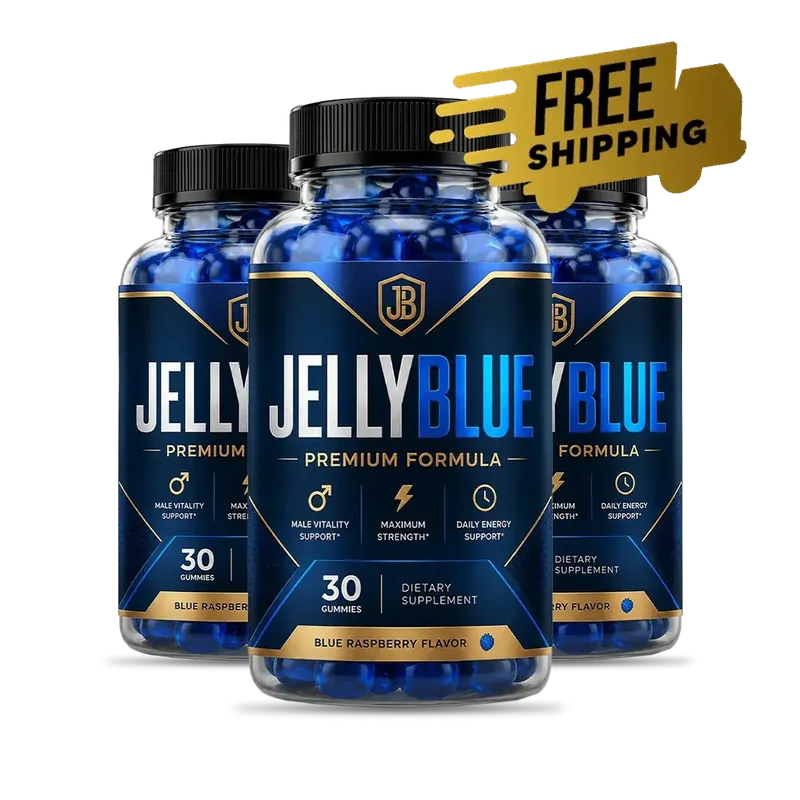
Packs of 1, 2, 3 or 6 bottles, 30 gummies each, priced on the secure order page. Every order has a 60-day money-back guarantee. Questions first? The contact page lists every desk.

Keep reading
Jellyblue Reviews
No stars, no counts, no testimonials, and a plain explanation of why none of them are here.
Read →QualityJellyblue Testing & Quality
Eleven seals on one sales page, and what each of them can and cannot tell a buyer.
Read →ResearchTongkat ali: what the evidence shows
The largest amount in the gummy at 200 mg, and how thin the human research behind it really is.
Read →