Label
Jellyblue Supplement Facts, Line by Line
Quick answer
One Jellyblue gummy is a serving, and each bottle has 30 servings.
Per gummy: 6 calories, 0 g fat, 2 g total carbohydrate and 1.5 g total sugars, then seven named actives adding up to 650 mg. Nine other ingredients follow the box.
See what each active is.
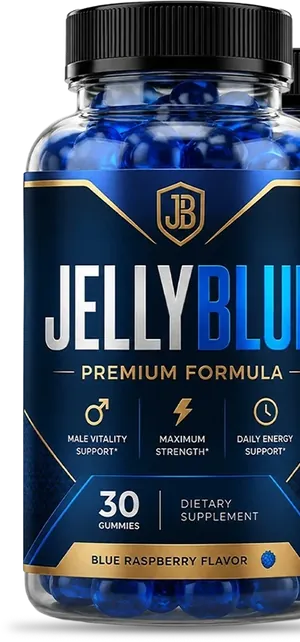
The panel
What does the Jellyblue Supplement Facts panel say?
Here is the panel, typed out from the label wrap. Serving size is one gummy, with 30 servings a bottle.
Six nutrition rows come first, then the seven named actives with a milligram figure each. The other ingredients sit under the box, where labels always put them.
Supplement Facts
Serving size: 1 gummy · Servings per container: 30
| Amount per serving | Amount | % Daily Value |
|---|---|---|
| Total Calories | 6 | ** |
| Total Fat | 0 g | 0% |
| Saturated Fat | 0 g | 0% |
| Trans Fat | 0 g | ** |
| Total Carbohydrate | 2 g | <1% |
| Total Sugars | 1.5 g | ** |
| L-Arginine HCl (amino acid) | 50 mg | ** |
| Tongkat Ali extract (Eurycoma longifolia) | 200 mg | ** |
| Maca root extract (Lepidium meyenii) | 100 mg | ** |
| Ashwagandha extract (Withania somnifera) | 100 mg | ** |
| Horny goat weed extract (Epimedium sagittatum) | 100 mg | ** |
| Beet root extract (Beta vulgaris) | 50 mg | ** |
| Grape seed extract (Vitis vinifera) | 50 mg | ** |
Percent Daily Values are based on a 2,000 calorie diet. ** Daily Value not established. The seven actives add up to 650 mg per gummy. Other ingredients, as printed: cane sugar, glucose syrup, water, pectin, citric acid, sodium citrate, natural flavor, natural coloring, starch. Allergen statement: not published.
What do the Jellyblue nutrition rows mean?
The top of the panel is ordinary food labeling. A gummy is a small candy carrying herbs, so it has calories and sugar in a way a capsule does not.
Six rows cover it. The last column below says what each one tells you in practice.
| Row | Printed amount | % Daily Value | What it tells you |
|---|---|---|---|
| Total Calories | 6 | no % shown | Six calories a gummy, from the sugars that hold it together. |
| Total Fat | 0 g | 0% | No fat. Saturated fat is listed separately and is also zero. |
| Saturated Fat | 0 g | 0% | Zero, as you would expect from a pectin gummy. |
| Trans Fat | 0 g | no DV set | No Daily Value exists for trans fat, so the panel carries a marker instead of a number. |
| Total Carbohydrate | 2 g | <1% | Two grams a gummy. The percentage is based on a 2,000 calorie diet. |
| Total Sugars | 1.5 g | no DV set | Most of the carbohydrate is sugar. Cane sugar and glucose syrup lead the other-ingredients line. |
Total sugars is the row worth pausing on. Added sugar means sugar put in during manufacturing rather than sugar that arrived inside a fruit (FDA, 2024). At 1.5 g a gummy, one a day is a small amount for most adults. Anyone counting sugar closely, for any reason, should still count it.
Why does every Jellyblue active say Daily Value not established?
Because no federal Daily Value exists for herbs. A Daily Value is a reference amount set for nutrients such as vitamin C or calcium. Tongkat ali, maca and the rest have none.
So the panel prints a marker in the percentage column instead of a number. That is normal labeling, and it appears on every botanical supplement sold in the United States.
What the marker does not mean
- It does not mean the amount is too small to matter
- It does not mean the ingredient is unapproved or unsafe
- It does not mean a government body has reviewed the formula
- It does not tell you how the 100 mg here compares with a study
What to use instead
- The milligram figure itself, which this label does publish for all seven
- The amounts used in published research, set out on the ingredients page
- The suggested use on the bottle, which is one gummy a day
- Your own doctor, if you take daily medicine
Where do these Jellyblue numbers come from?
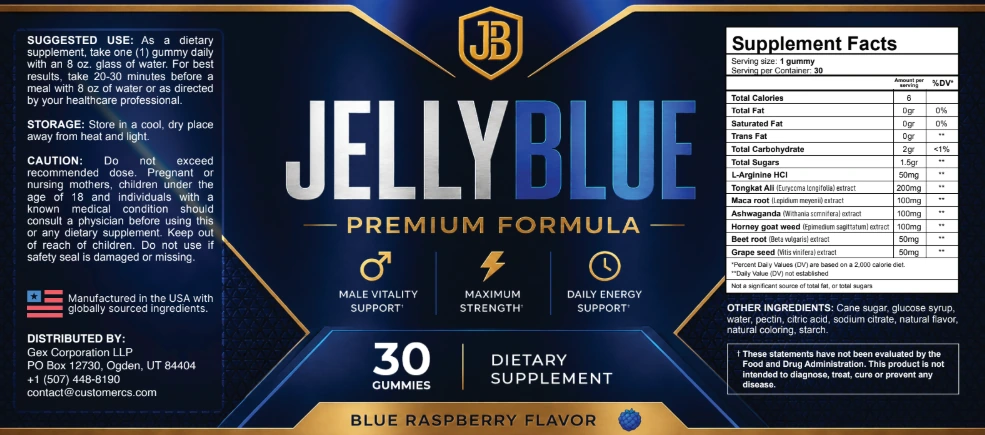
From one photo of the full label wrap, taken flat so the whole panel is readable.
That matters, because product pages in this category often carry amounts that never appear on the bottle. Here the wrap is legible end to end, so the transcription can be checked rather than trusted.
Two small spellings on the printed panel differ from standard usage: it reads 'Ashwaganda' and 'Horney goat weed', and this site uses the standard spellings throughout.
The label also carries the brand line 'JELLYBLUE PREMIUM FORMULA', the three starred claims, '30 GUMMIES', 'DIETARY SUPPLEMENT' and 'BLUE RASPBERRY FLAVOR'.
What is in the Jellyblue other-ingredients line?
Nine items, in this order: cane sugar, glucose syrup, water, pectin, citric acid, sodium citrate, natural flavor, natural coloring, starch.
Order matters. Ingredients are listed by weight, so cane sugar and glucose syrup outweigh the pectin, acids, flavor, color and starch that follow.
Who distributes Jellyblue, and which number is on the label?
The panel ends with a distributor block, and it is worth reading closely. It names Gex Corporation LLP, PO Box 12730, Ogden, UT 84404, with its own phone line and email (as printed on the label; both are listed in the site footer).
It also says the product is manufactured in the USA with globally sourced ingredients. The plant itself is not named, so the label tells you who put the product into distribution, not who made it.
| Block | What the label prints | What it tells you |
|---|---|---|
| Serving size | 1 gummy | One gummy is the whole serving. There is no two-gummy option on the panel. |
| Servings per container | 30 | Thirty gummies a bottle, so a bottle is 30 days at the suggested use. |
| Named actives | 7 lines, 650 mg | Each active carries its own milligram figure. None of them are pooled into a blend. |
| Other ingredients | 9 items | Cane sugar first, starch last. This line is not part of the Facts box. |
| Allergen statement | not published | Nothing is printed. No 'contains' line and no 'may contain' line. |
| Distributed by | Gex Corporation LLP, Ogden, UT | A distributor address, not a factory address. The manufacturer is not named. |
The phone number trap
The number printed on the label belongs to the distributor in Ogden, Utah. It is not the order desk.
Tracking, changes and refunds go through the order desk instead. Anyone who reads the bottle and dials the printed number is calling the wrong place for a refund, and the 60-day window keeps running while they work that out. The refund policy sets out the right route.
How do you check the panel on your own Jellyblue bottle?
Print runs change. The bottle in your hand is the only panel that governs what you swallow, so spend four minutes on it.
Find the serving line
It should read one gummy, 30 servings per container. A different serving size changes every other figure.
Read the six nutrition rows
6 calories, 0 g fat, 0 g saturated fat, 0 g trans fat, 2 g carbohydrate, 1.5 g sugars.
Count seven actives
Seven lines, 650 mg in total, each with its own milligram figure. Six lines or a blend total means a reformulation.
Read past the box
The other-ingredients line, then any allergen wording. If an allergen statement has been added, that is new and welcome.
Check the distributor block
Name, PO Box address and the distributor’s phone number. Keep the order desk number separate in your phone.
Note the lot
Lot JEL-26/JE-2675 and CoA JEL-2675-26-JE are reference codes for matching an order. Batch verify explains their limits.
A panel that does not match this page is worth reporting. Write to the website inbox in the site footer, and the transcription gets corrected. That inbox cannot see orders, so anything about a delivery goes to the order desk.
Jellyblue label questions, answered from the panel
How many calories are in one Jellyblue gummy?
Six, alongside 2 g of total carbohydrate and 1.5 g of total sugars. The panel lists zero fat, zero saturated fat and zero trans fat.
What does the double asterisk on the Jellyblue panel mean?
It marks a nutrient with no Daily Value set. All seven actives carry it, and so do trans fat and total sugars. It says nothing about strength or quality.
Does Jellyblue publish an allergen statement?
No. Nothing follows the other-ingredients line, so there is no 'contains' or 'may contain' wording to read. The gluten-free and dairy-free seals are claims without that statement behind them.
Who distributes Jellyblue?
The panel prints Gex Corporation LLP, Ogden, UT. The label also says the product is manufactured in the USA with globally sourced ingredients. The factory itself is not named.
Is the phone number on the Jellyblue label the customer service line?
It is the distributor’s number, listed in the site footer. Tracking, changes and refunds go through the order desk instead. Two numbers, two jobs.
How much of each active is in a Jellyblue gummy?
Tongkat ali 200 mg, maca root 100 mg, ashwagandha 100 mg, horny goat weed 100 mg, beet root 50 mg, grape seed 50 mg and L-arginine HCl 50 mg. The ingredients page compares them with research amounts.
Does the Jellyblue panel list vitamins or minerals?
No. There are no vitamins, no minerals and no % Daily Value figures except the ones on fat and carbohydrate. The seven actives are herbal extracts plus one amino acid.
Can I trust this transcription?
It comes from the label wrap photo, which is legible, and it is the source for every number on this site. Compare it with the bottle you receive and write to the website inbox in the site footer if a line differs.
References
- U.S. Food and Drug Administration (2024). Added Sugars on the Nutrition Facts Label.
Ready when you are
Order Jellyblue from the authorized outlet
Packs of 1, 2, 3 or 6 bottles, 30 gummies each, priced on the secure order page. Every order has a 60-day money-back guarantee. Questions first? The contact page lists every desk.

Keep reading
Jellyblue Ingredients
All seven named actives, their milligrams, and the one the sales page leaves out.
Read →Daily useHow To Use Jellyblue
One gummy, 8 oz of water, 20 to 30 minutes before a meal, and what to do on an off day.
Read →QualityJellyblue Batch Verify
What the lot and CoA numbers really are, and the checks to run the minute a bottle lands.
Read →