Ingredients
Jellyblue Ingredients and Amounts per Gummy
Quick answer
The Jellyblue label names seven actives and prints a milligram figure for each one, 650 mg per gummy.
Tongkat ali comes first at 200 mg; maca root, ashwagandha and horny goat weed give 100 mg each; beet root, grape seed and L-arginine HCl give 50 mg each.
Read the label panel line by line.
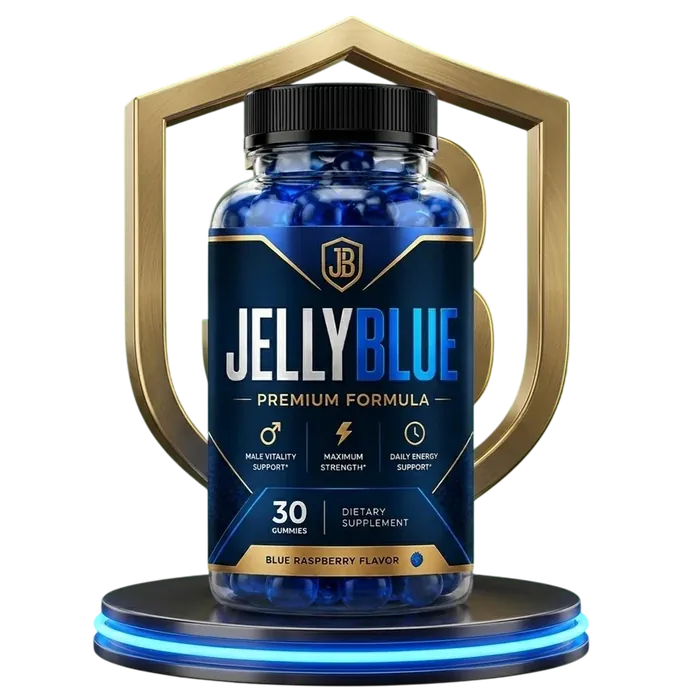
The short version
What is in a Jellyblue gummy, and how much of each?
Seven named actives, and the label prints a milligram figure beside each one. Added together they come to 650 mg in a single gummy.
Start with the good news. Most gummies in this aisle bury their herbs in a proprietary blend, so you see one total and never the parts. Jellyblue does not.
| Named active | Source | Per gummy | Share of the 650 mg |
|---|---|---|---|
| Tongkat ali extract | Eurycoma longifolia | 200 mg | 31% |
| Maca root extract | Lepidium meyenii | 100 mg | 15% |
| Ashwagandha extract | Withania somnifera | 100 mg | 15% |
| Horny goat weed extract | Epimedium sagittatum | 100 mg | 15% |
| Beet root extract | Beta vulgaris | 50 mg | 8% |
| Grape seed extract | Vitis vinifera | 50 mg | 8% |
| L-Arginine HCl | amino acid | 50 mg | 8% |
Why does Jellyblue list seven actives but advertise six?
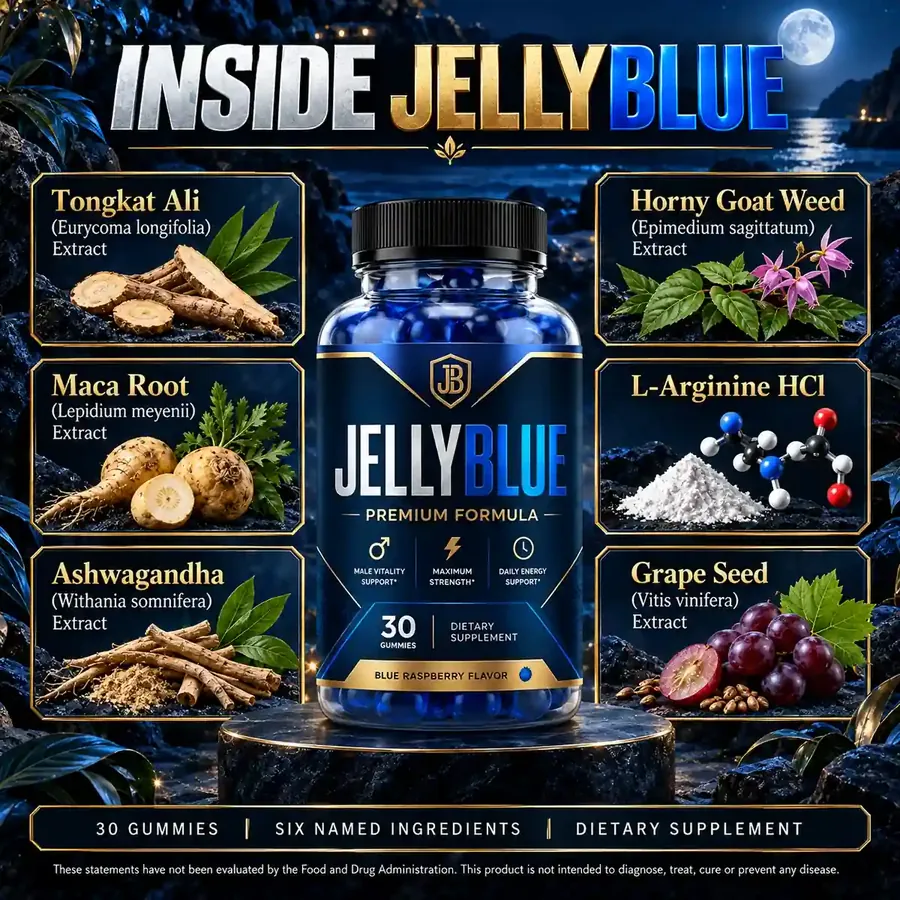
The panel lists seven. The sales page lists six. Beet root extract, 50 mg, is the one that goes missing.
It sits on the Supplement Facts panel with an amount beside it. It is absent from the 'Inside Jellyblue' graphic and from the sales page. No reason is given for the gap.
When two documents disagree, the label wins. It is the regulated one, printed on the bottle in your hand. So this site counts seven actives and 650 mg.
What is each named Jellyblue active?
Tap through the seven below. Each tab gives the plant, what it is known for, and the printed amount.
Named active 1 of 7
L-Arginine HCl
The body turns arginine into nitric oxide, which relaxes blood vessels. Exercise and blood-flow studies use grams a day, not milligrams.
- Amount
- 50 mg per gummy, from the label panel
- Source
- amino acid
Named active 2 of 7
Tongkat Ali extract
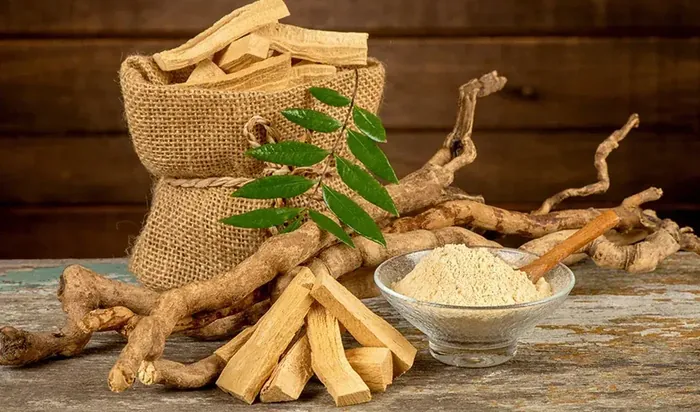
A Malaysian root, the largest single amount here. Human trials are small and there is no NIH fact sheet for it.
- Amount
- 200 mg per gummy, from the label panel
- Source
- Eurycoma longifolia
Named active 3 of 7
Maca root extract
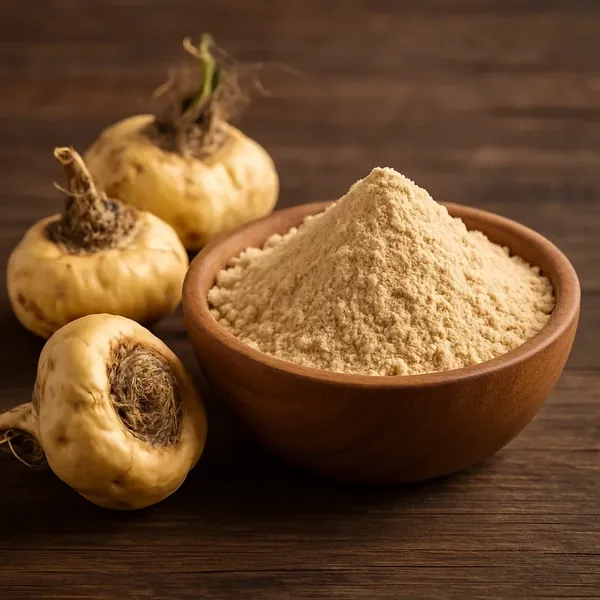
A Peruvian root vegetable. A systematic review found the evidence for sexual function too limited to judge.
- Amount
- 100 mg per gummy, from the label panel
- Source
- Lepidium meyenii
Named active 4 of 7
Ashwagandha extract
An Ayurvedic root studied for stress and sleep. Most trials use 300 to 600 mg; rare liver injury has been reported.
- Amount
- 100 mg per gummy, from the label panel
- Source
- Withania somnifera
Named active 5 of 7
Horny goat weed extract
A traditional Chinese herb. Its compound icariin is studied mostly in the laboratory, with little human data.
- Amount
- 100 mg per gummy, from the label panel
- Source
- Epimedium sagittatum
Named active 6 of 7
Beet root extract
A nitrate source studied for blood flow and exercise, usually as concentrated juice rather than a 50 mg extract.
- Amount
- 50 mg per gummy, from the label panel
- Source
- Beta vulgaris
Named active 7 of 7
Grape seed extract
Rich in proanthocyanidins; studied for blood pressure and cholesterol with small effects, usually at 100 to 300 mg.
- Amount
- 50 mg per gummy, from the label panel
- Source
- Vitis vinifera
Notice the shape of the formula. One active carries 200 mg, three sit at 100 mg, and three trail at 50 mg.
How do the Jellyblue amounts compare with research?
Here the honesty gets uncomfortable. The amounts are real and published, yet most sit under what studies have used. Read the table as a reality check, not as a verdict on the gummy.
| Active | On the label | What research has used |
|---|---|---|
| Tongkat ali | 200 mg | Human trials are small and no federal fact sheet exists. The amount here is roughly the range those trials used. |
| Maca root | 100 mg | Studies used about 1.5 to 3 grams a day, and a review found the evidence for sexual function too limited to judge (Shin et al., 2010). |
| Ashwagandha | 100 mg | Most trials use 300 to 600 mg a day, and the data covers two to four months (NCCIH, 2023). |
| Horny goat weed | 100 mg | Little human research, and no federal fact sheet. Nothing solid to compare 100 mg against. |
| Beet root | 50 mg | Nitrate work uses concentrated beetroot juice rather than a 50 mg extract (NIH ODS). |
| Grape seed | 50 mg | Usually studied at 100 to 300 mg, for blood pressure and cholesterol, with small effects (NCCIH, 2025). |
| L-Arginine HCl | 50 mg | Blood-flow and exercise research uses grams a day, so 50 mg is a tiny fraction of it (NIH ODS). |
What that means in practice
- Tongkat ali at 200 mg is the one active in the researched range
- Maca at 100 mg is far under the grams used in trials
- Ashwagandha at 100 mg is a third of the usual amount
- Arginine at 50 mg is milligrams where research uses grams
No study has been published on the finished formula. Seven herbs together are not seven herbs apart.
What else is in a Jellyblue gummy besides the actives?
A gummy has to be a gummy. Nine other ingredients do that job, and two of them are sugars.
The line reads: cane sugar, glucose syrup, water, pectin, citric acid, sodium citrate, natural flavor, natural coloring, starch. Cane sugar and glucose syrup lead it, so they weigh more than anything after them.
No allergen statement is published on the wrap. The gluten-free, dairy-free and vegetarian seals stand without one, so they remain seal claims. If you react to foods, call the order desk before you buy.
Which Jellyblue ingredients should you raise with a doctor?
Four of the seven touch systems that common prescriptions also touch. Read this twice if you take anything daily.
- Ashwagandha may interact with thyroid medicine, and rare liver-injury reports exist (NCCIH, 2023)
- Grape seed may add to the effect of blood thinners (NCCIH, 2025)
- Arginine and beet root both act on blood flow, so nitrate and blood-pressure medicine is a doctor question
- Ashwagandha is not for pregnancy or breastfeeding, and this product is for adults 18 and over
One more point matters more than any milligram here. Trouble with erections or drive can be an early sign of heart disease or diabetes. See a doctor first, then decide about supplements. The side effects page goes through each interaction in full.
How do you check the Jellyblue ingredients on your own bottle?
Formulas get reworked between print runs. Four minutes with the bottle settles what you actually bought.
Turn the bottle to the panel
Find the Supplement Facts box. It is the only place amounts are set out.
Count the actives
Seven lines under the nutrition rows, ending at 650 mg. Six lines means a different formula.
Check the four biggest
Tongkat ali 200 mg, then maca, ashwagandha and horny goat weed at 100 mg. Those four are 77% of the blend.
Read the other-ingredients line
Nine items, starting with cane sugar. A new allergen statement would show here.
Match the lot
Lot JEL-26/JE-2675 and CoA JEL-2675-26-JE are reference codes for this run. Batch verify explains their limits.
Anything on your bottle that disagrees with this page wins.
Jellyblue ingredients: questions buyers ask
How many ingredients does Jellyblue have?
The Supplement Facts panel names seven actives, plus nine other ingredients that build the gummy itself. The sales page and the 'Inside Jellyblue' graphic name six actives, because beet root is left off both.
Does Jellyblue use a proprietary blend?
No. Every one of the seven actives carries its own milligram figure on the panel. That is unusual in this category, where amounts are often hidden inside one blend total.
Which Jellyblue ingredient is the biggest?
Tongkat ali extract at 200 mg. It is almost a third of the 650 mg total, and the next three actives sit at 100 mg each.
Why is beet root missing from the Jellyblue sales page?
The seller does not say. The panel prints beet root extract at 50 mg, and the label is the document that has to be accurate, so this site counts seven.
Are the Jellyblue amounts high?
Honest but small. Tongkat ali at 200 mg lands near the range of the small trials done on it. Maca, ashwagandha, grape seed and arginine all sit under researched amounts.
What are the non-active ingredients in Jellyblue?
Cane sugar, glucose syrup, water, pectin, citric acid, sodium citrate, natural flavor, natural coloring and starch. The full panel has the nutrition rows.
References
- U.S. Food and Drug Administration (2024). Added Sugars on the Nutrition Facts Label.
- National Center for Complementary and Integrative Health (2023). Ashwagandha: Usefulness and Safety.
- National Center for Complementary and Integrative Health (2025). Grape Seed Extract: Usefulness and Safety.
- NIH Office of Dietary Supplements (accessed 2026). Dietary Supplements for Exercise and Athletic Performance.
- Shin BC, Lee MS, Yang EJ, Lim HS, Ernst E (2010). Maca (L. meyenii) for improving sexual function: a systematic review, in BMC Complementary and Alternative Medicine 10:44.
Ready when you are
Order Jellyblue from the authorized outlet
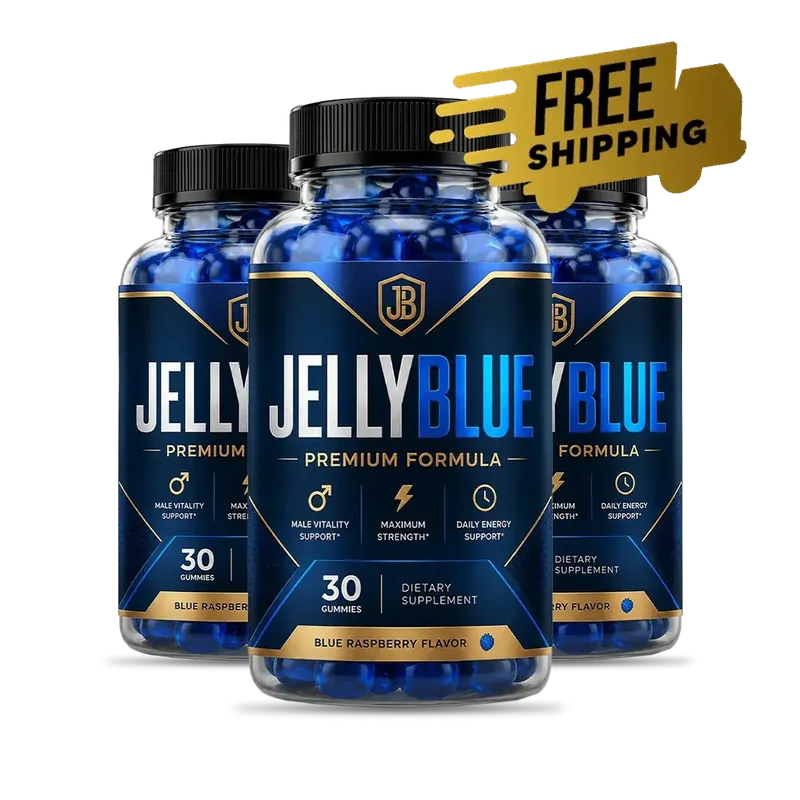
Packs of 1, 2, 3 or 6 bottles, 30 gummies each, priced on the secure order page. Every order has a 60-day money-back guarantee. Questions first? The contact page lists every desk.

Keep reading
Jellyblue Supplement Facts
The whole label panel typed out: nutrition rows, actives, other ingredients and the distributor block.
Read →The productHow Jellyblue Works
Each of the seven actives, what it is known for, and how 650 mg measures up to research.
Read →SafetyJellyblue Side Effects
Every caution worth naming: interactions, the sugar, who is ruled out and when to stop.
Read →