Batch verify
Jellyblue Batch Verify: Lot Numbers and Bottle Checks
Quick answer
Lot JEL-26/JE-2675 and CoA reference JEL-2675-26-JE are labels for matching an order to a production run. They are not lab proof, and no certificate is published for you to read. Lot and best-before are printed on the base of the bottle when the bottle shows them. Check the safety seal before anything else.
Start here
What are the Jellyblue lot and CoA numbers?
They are reference labels. Lot JEL-26/JE-2675 identifies a production run, and CoA reference JEL-2675-26-JE is the file name a seller can quote when someone queries an order.
Neither is evidence about the contents of your bottle. No certificate is published, so nothing here has been read, checked or verified by anyone you can see.
| Number or mark | What it is | What it is not |
|---|---|---|
| Lot JEL-26/JE-2675 | A reference label used to match an order to a production run | Not a test result, and not a lab document |
| CoA reference JEL-2675-26-JE | A file name a seller can quote when an order is queried | Not a certificate you have been shown |
| Best-before date | Lot and best-before are printed on the base of the bottle when the bottle shows them | Not a quality grade; it is a date |
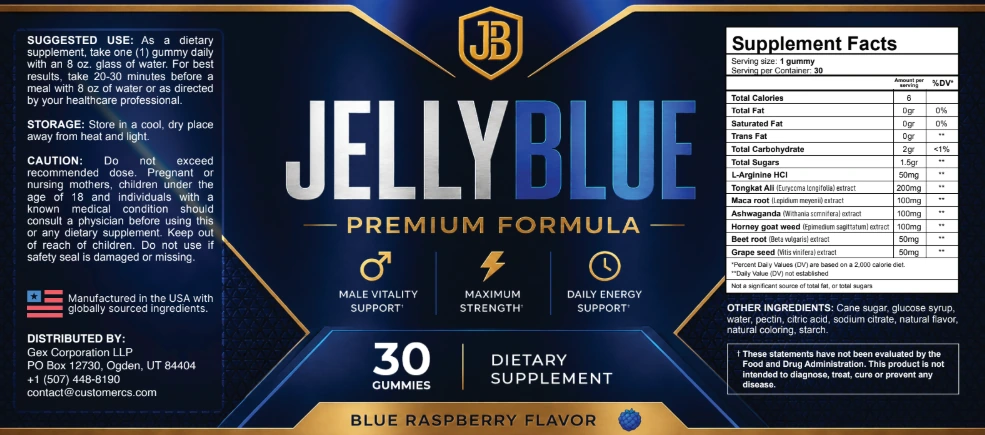
| Serving panel on the wrap | The seven actives and their milligrams | The one printed source every number on this site copies |
| Seals on the sales page | Artwork describing the product and the facility | Not lab results for your bottle |
Where are the Jellyblue lot number and best-before printed?
On the base of the bottle, when the bottle shows them. That is the published position, and it is where to look first.
The wrap itself carries the Supplement Facts panel, the suggested use, the storage line and the distributor details. Every number on this site is copied from that wrap, which is why it is worth reading once rather than glancing at.
- Base of the tub: lot code and best-before, when printed
- Wrap: Supplement Facts, seven actives with milligrams
- Wrap: suggested use and the storage line
- Wrap: Gex Corporation LLP, Ogden, UT as the distributor
If the base is blank, the code may be on the wrap instead. Check both before deciding anything is missing, and photograph whatever you find so the desk can see it too.
What should you check when a Jellyblue bottle arrives?
Six checks, in this order, before the first gummy. They take a couple of minutes and they are far easier to act on while the parcel is still open on the table.
Check the safety seal
Run a finger around the cap. A seal that is loose, split or missing ends the inspection right there.
Look at the label wrap
It should sit straight and read cleanly. A smeared or peeling wrap is worth a photograph before anything else happens.
Read the Supplement Facts panel
Seven actives, each with milligrams beside it, adding up to 650 mg per gummy.
Turn the bottle over
Note the lot and the best-before if they are printed there, then write them down somewhere other than the bottle.
Count and look at the gummies
Thirty, blue raspberry flavor, separate rather than fused. Heat in transit is the usual reason they stick.
Store it properly
Keep it in a cool, dry place away from heat and light, as the label asks. A cupboard suits a chewable better than a car or a window sill.
Anything that fails one of those checks is a call to the order desk (number in the site footer) with the order ID.
What does the Jellyblue safety seal tell you?
That the tub has not been opened since it left the packer. It is the one check the label itself instructs you to make, and it is the check people skip when a parcel arrives late.
A seal proves one narrow thing: nobody opened the tub in transit. It says nothing about what went into the tub before it was sealed.
What would real lab proof look like, and is any published?
None is published for this product. It is worth knowing what would be there if it were, because that is how you tell a document from a file name.
A certificate of analysis is a report from a testing laboratory. The parts below are what make such a report checkable by a reader.
A named laboratory
With an address, so the report can be traced to the people who ran it.
A dated batch
Tied to a specific lot, because a result belongs to one run.
Named tests and limits
What was measured and the limit applied. A result with no limit cannot pass or fail.
Actual figures and a signature
Numbers per test, signed by someone at the lab. Words like clean and pure are not measurements.
Set that list against JEL-2675-26-JE, a reference string with none of those parts attached.
Why batch checking matters more in this category
Men's products sold online are a repeat target for adulteration. FDA maintains a running list of sexual enhancement products found to contain undeclared prescription drug ingredients (FDA, 2026).
That is not an accusation about this formula. It is the reason to buy through the authorized order page, keep the order email, and look at what actually arrives.
- A supplement bought from an unknown marketplace seller has no traceable batch
- A bottle with no code cannot be tied to a run if a question comes up later
- A seal that arrives broken removes the only tamper check you have
- A panel that does not match the published one is a question, not a curiosity
Erection or drive problems can signal heart disease or diabetes, so the safer route is a doctor rather than a stronger-sounding product from an unfamiliar shop.
What do you do if something does not match?
Call the order desk with the order ID, the lot code and a photograph. The table pairs each check above with what to do when it fails.
| What you check | What it should look like | If it does not |
|---|---|---|
| Safety seal | Intact, flat, unbroken around the cap | Do not chew a gummy; call the order desk |
| Label wrap | Legible, straight, not peeling | Photograph it and call before opening |
| Supplement Facts panel | Seven actives, amounts as printed here | Compare with the panel page and query the difference |
| Bottle base | Lot and best-before, when the bottle shows them | Note what is there and mention it on the call |
| Count | 30 gummies, blue raspberry flavor | Short count is an order desk question, not a lab one |
| Gummy condition | Separate, firm, not fused into a block | Heat in transit is the usual cause; ask before taking one |
Keep the tub, the wrap and the outer box together while a query is open. A question about a batch is much easier to answer while the evidence still exists in one place.
What is not published about Jellyblue batches?
A short list, stated plainly, because a gap named is more useful than a gap filled with guesses.
- Any laboratory report, for any batch
- The name of the facility that produced the gummies
- Which tests, if any, are run on a finished batch
- How long a batch stays in date from its production run
- Whether the lot shown on the sales page matches the tub you receive
What is published is the label panel, and it is unusually specific: every active carries a real milligram figure. The Supplement Facts page transcribes it, and the seals page works through the marks beside it.
Jellyblue batch and bottle checks: common questions
Does lot JEL-26/JE-2675 prove Jellyblue was tested?
No. It is a reference label that lets a seller match an order to a run of product. A lot number on its own says nothing about what was measured, by whom, or with what result.
Can I download the CoA JEL-2675-26-JE?
No certificate is published on this site and none was supplied with the pack. The reference exists so that a query can be tied to a batch; treat it as an index entry rather than a document you have read.
Where is the lot number on the bottle?
Lot and best-before are printed on the base of the bottle when the bottle shows them. Some tubs in this category carry it on the wrap instead, so check both before you decide it is missing, then call the desk if you cannot find it.
What if my bottle has no lot number at all?
Photograph the base and the wrap, then call the order desk with the order ID. A missing code is worth a question; it is also worth keeping the bottle unopened while you ask.
The safety seal was broken. What now?
Do not chew a gummy. The label says not to use the product if the safety seal is damaged or missing, so the bottle goes back in the box and the call to the order desk happens the same day.
Should the numbers on my bottle match the ones on this page?
Not necessarily. Production runs change, so a different lot is normal. What matters is that the bottle carries a code at all and that the Supplement Facts panel reads the way the published panel does.
Does a batch number tell me the gummies are pure?
It does not. Purity is a measurement, and no measurement for this product is published. The word pure appears on a seal, and the seals page explains what a seal can and cannot carry.
Why does any of this matter for a men's supplement?
Because FDA keeps finding hidden prescription drugs in men's products sold online (FDA, 2026). Buying through the authorized route and checking the bottle on arrival are the two habits that protect you.
References
- U.S. Food and Drug Administration (2026). Tainted Sexual Enhancement Products.
Ready when you are
Order Jellyblue from the authorized outlet
Packs of 1, 2, 3 or 6 bottles, 30 gummies each, priced on the secure order page. Every order has a 60-day money-back guarantee. Questions first? The contact page lists every desk.

Keep reading
Jellyblue Testing & Quality
Eleven seals on one sales page, and what each of them can and cannot tell a buyer.
Read →The productJellyblue Supplement Facts
The whole label panel typed out: nutrition rows, actives, other ingredients and the distributor block.
Read →SafetyJellyblue Side Effects
Every caution worth naming: interactions, the sugar, who is ruled out and when to stop.
Read →