How it works
How Jellyblue Works, One Active at a Time
Quick answer
Jellyblue combines seven herbal and amino acid actives, 650 mg in total, in one daily gummy.
Each active has its own research record, and together they are made for male vitality support and daily energy support.
See the milligrams of each active.
The claim
What is Jellyblue meant to do?
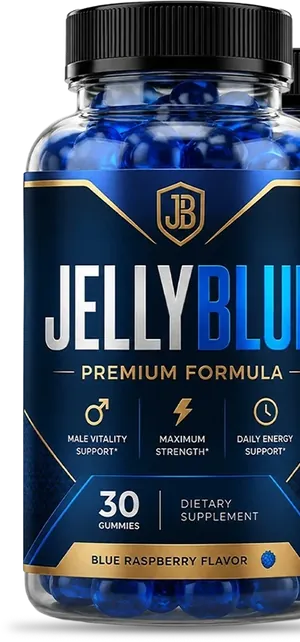
The bottle carries three starred claims: male vitality support, maximum strength and daily energy support. The star points to the standard FDA notice.
Read the wording. Every claim is a support claim. Nothing on the label says a gummy fixes, treats or restores anything.
- Jellyblue
- Premium Formula
- Male vitality support
- Maximum strength
- Daily energy support
- 30 gummies
- Dietary supplement
- Blue raspberry flavor
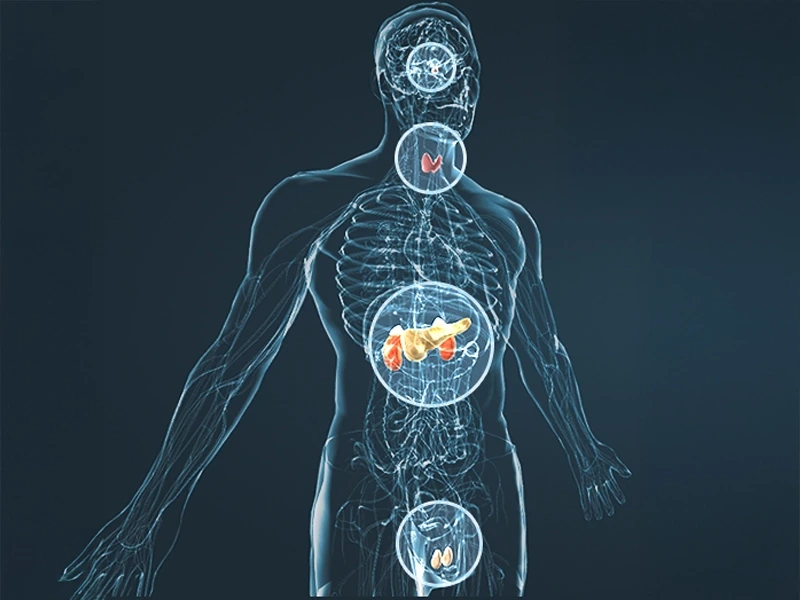
The sales page pairs those claims with a diagram of energy flowing upward. It looks like biology. It is illustration.
No trial has been published on the finished gummy, so nothing in that picture has been measured. The honest version is simpler: seven ingredients, each with its own research record, at amounts the label prints openly.
What would a 650 mg gummy actually be doing?
Two rough ideas sit behind a formula like this. Neither has been tested in this gummy.
The first is nitric oxide. The body makes it from arginine and from dietary nitrate, and it relaxes blood vessels (NIH ODS). Arginine, beet root and grape seed point at that idea.
The second is the adaptogen idea: herbs taken daily to help the body handle stress. Ashwagandha, maca, tongkat ali and horny goat weed come from that tradition.
What is each Jellyblue active known for on its own?
Seven entries, in label order. Each gives the amount, what the ingredient is known for, and where the research stands.
L-Arginine HCl, 50 mg
An amino acid the body converts into nitric oxide, which relaxes blood vessel walls. That is textbook biology, and it is why arginine appears in sports products. The catch is size. Blood-flow studies use grams a day (NIH ODS), so 50 mg is a small fraction of that.
Tongkat ali extract, 200 mg
A Malaysian root used as a tonic, and the largest single amount here. Human trials are small and no federal agency publishes a fact sheet for it, so the evidence stays limited. Still, 200 mg falls in the same neighborhood as those trials, which is more than most ingredients here manage.
Maca root extract, 100 mg
A Peruvian root vegetable eaten as food. A systematic review of maca for sexual function found the evidence too limited to draw a conclusion (Shin et al., 2010). Those trials used roughly 1.5 to 3 grams a day. This gummy has 100 mg.
Ashwagandha extract, 100 mg
An Ayurvedic root studied mainly for stress and sleep. NCCIH describes human data covering two to four months, notes rare liver-injury reports, and flags possible interaction with thyroid medicine (NCCIH, 2023). Most of those studies used 300 to 600 mg a day.
Horny goat weed extract, 100 mg
A traditional Chinese herb whose compound icariin is studied mostly in the laboratory. Human research is scarce and no federal fact sheet exists, so there is no accepted amount to compare against.
Beet root extract, 50 mg
A nitrate source, and the ingredient the sales page forgets. Nitrate research is real, but it runs on concentrated beetroot juice in quantities you drink (NIH ODS). A 50 mg dried extract is not that in a smaller cup.
Grape seed extract, 50 mg
Rich in proanthocyanidins, and the best documented of the small three. NCCIH reports study for blood pressure and cholesterol, with small effects (NCCIH, 2025). Those studies typically use 100 to 300 mg.
How does 650 mg compare with the research amounts?
Most of the gummy sits under the amounts studies have used. The table puts the label figure and the research record side by side.
Nothing in it says the product does nothing. It says evidence cannot be borrowed from studies run at different amounts.
| Active | Per gummy | Evidence base | How the amount measures up |
|---|---|---|---|
| Tongkat ali | 200 mg | Small human trials, no federal fact sheet | Thin but real. This is the one active sitting near the amounts those trials used. |
| Maca root | 100 mg | A systematic review of sexual function (Shin et al., 2010) | The review called the evidence too limited to judge. Trials used grams, not 100 mg. |
| Ashwagandha | 100 mg | Reviewed by NCCIH (NCCIH, 2023) | Data runs two to four months, usually at 300 to 600 mg. This is a third of that. |
| Horny goat weed | 100 mg | Laboratory work on icariin, little human data | Nothing to compare against, and no federal fact sheet. |
| Beet root | 50 mg | Nitrate research (NIH ODS) | That research uses concentrated juice. A 50 mg extract is a different thing. |
| Grape seed | 50 mg | Reviewed by NCCIH (NCCIH, 2025) | Studied for blood pressure and cholesterol with small effects, usually at 100 to 300 mg. |
| L-Arginine HCl | 50 mg | Exercise and blood-flow research (NIH ODS) | Those studies use grams a day. |
What Jellyblue gets right, and where it falls short
The formula deserves credit in one specific place and criticism in another. Both are visible on the label.
Pros
- Every active carries its own milligram figure, with no proprietary blend
- Tongkat ali, the lead ingredient, is at an amount small trials have actually used
- Seven actives are named on the panel, so nothing is hidden behind a total
- One gummy a day is simple to keep to, and the directions are printed plainly
Cons
- Maca, ashwagandha, grape seed and arginine all sit below researched amounts
- No trial has ever been run on the finished gummy
- Beet root is on the panel but missing from the sales page and the ingredient graphic
- Each gummy carries 1.5 g of sugar, and cane sugar leads the other-ingredients line
Put together, this is a modest formula that documents itself well. The ingredients page reaches the same conclusion from the same numbers.
What should you settle before the first gummy?
Two things, and neither takes long. The first is medical, the second is about where you buy.
- Ashwagandha may interact with thyroid medicine, and rare liver-injury reports exist (NCCIH, 2023)
- Arginine and beet root both act on blood flow, so nitrate and blood-pressure medicine is a doctor question
- Trouble with erections or drive can be an early sign of heart disease or diabetes, which is a reason to be examined rather than to self-treat
- FDA keeps finding hidden prescription drugs in men's products sold online (FDA, 2026)
That last point is the argument for the authorized route. A gummy from a marketplace reseller has an unknown history, and a tainted product carries no warning. The official route keeps the chain short.
How do you take Jellyblue the way the label describes?
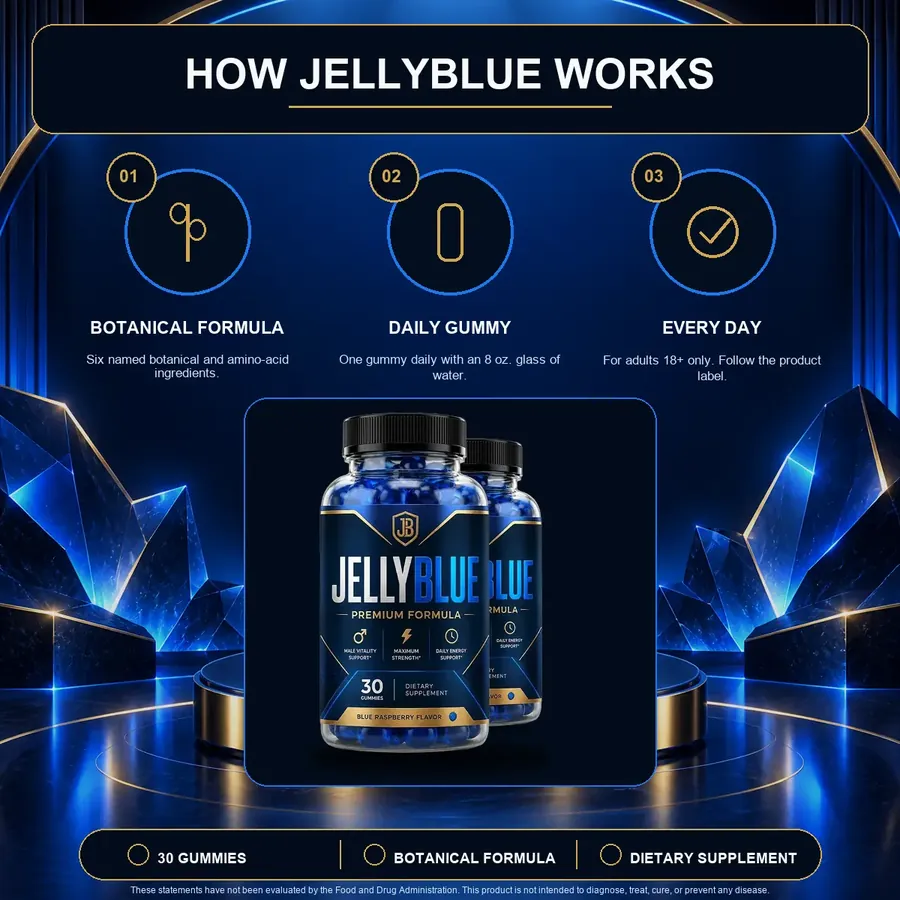
The label keeps it short: As a dietary supplement, take one gummy daily with an 8 oz glass of water. For best results, take it 20 to 30 minutes before a meal with 8 oz of water, or as directed by your healthcare professional.
Storage is equally plain. Keep it in a cool, dry place away from heat and light, as the label asks. A gummy is a food, and heat spoils one.
The routine is the part you control. An ingredient at 100 mg cannot make up for a bottle taken twice a week.
One gummy, one glass of water
The serving is a single chewable gummy, taken with 8 oz of water.
Twenty to thirty minutes before a meal
The label's own suggestion for best results. It gives no reason.
Same time every day
Herbal research measures weeks, not hours. Regularity is what makes it meaningful.
Never double up
Do not exceed the recommended dose. A missed day is not a reason to chew two.
Write down what you notice
Sleep, energy, mood. Your own notes beat any listing graphic.
Full directions and missed-day advice are on the how to use page.
How Jellyblue works: the questions behind the claims
How is Jellyblue supposed to work?
Through seven named actives at 650 mg a gummy. Three touch blood flow and four are traditional tonic herbs. The label frames all of it as support, not treatment.
How long before Jellyblue does anything?
No timeline is published, and none should be. Herbal trials usually run weeks rather than days. The results timeline page explains why any promised date is a sales device.
Is there a study on the Jellyblue formula itself?
No. Research exists on some of the single ingredients. Seven extracts chewed together in a sugar gummy have not been tested as a combination.
Which Jellyblue ingredient has the most research behind it?
Ashwagandha and grape seed have the clearest reviews, both from NCCIH. Tongkat ali is the most relevant here, but its trials are small.
Does the 650 mg total mean it is strong?
Not on its own. A total only matters once you know how it splits. Here 200 mg goes to tongkat ali and the rest is spread thin across six more actives.
Can Jellyblue replace medicine for a blood-flow problem?
No. It is a dietary supplement, not a drug, and it is not intended to diagnose, treat, cure or prevent any disease. Persistent problems belong with a doctor.
References
- U.S. Food and Drug Administration (2026). Tainted Sexual Enhancement Products.
- National Center for Complementary and Integrative Health (2023). Ashwagandha: Usefulness and Safety.
- National Center for Complementary and Integrative Health (2025). Grape Seed Extract: Usefulness and Safety.
- NIH Office of Dietary Supplements (accessed 2026). Dietary Supplements for Exercise and Athletic Performance.
- Shin BC, Lee MS, Yang EJ, Lim HS, Ernst E (2010). Maca (L. meyenii) for improving sexual function: a systematic review, in BMC Complementary and Alternative Medicine 10:44.
Ready when you are
Order Jellyblue from the authorized outlet
Packs of 1, 2, 3 or 6 bottles, 30 gummies each, priced on the secure order page. Every order has a 60-day money-back guarantee. Questions first? The contact page lists every desk.

Keep reading
Jellyblue Ingredients
All seven named actives, their milligrams, and the one the sales page leaves out.
Read →The productJellyblue Benefits
The three starred claims on the bottle, read plainly, plus the things this gummy is not made to do.
Read →ExpectationsJellyblue Results Timeline
Week by week with no promises, and the one clock on this product that is real.
Read →